Key takeaways
- NVMe delivers 3500-7000 MB/s versus SATA’s 560 MB/s ceiling, with Gen3 NVMe costing only $5-15 more per terabyte in 2026.
- M.2 slot keying determines compatibility: M-key supports NVMe only, B+M supports SATA or PCIe x2, and your motherboard manual lists which slots support which protocols.
- Boot drives and active project storage benefit from NVMe’s random IOPS; game libraries and media archives see minimal real-world improvement over SATA.
- NVMe Gen4 drives throttle from 5000 MB/s to 1800 MB/s without heatsinks due to thermal limits; SATA runs 15-20°C cooler with no throttling.
- Check your motherboard’s M.2 slot wiring before buying—some slots disable SATA ports when populated or only support specific PCIe generations.
SATA and NVMe are two protocols for talking to solid-state drives. SATA uses the older AHCI command set and runs over SATA ports or M.2 slots with B+M keying. NVMe uses the PCIe bus directly through M.2 slots with M-key or PCIe add-in cards. The speed gap is real—manufacturer spec sheets show NVMe Gen4 drives rated at up to 7000 MB/s sequential reads while SATA is capped by the interface at 560 MB/s—but many consumer tasks never push sustained sequential throughput long enough to notice.
Speed: Published Specifications
SATA III delivers 6 Gbps theoretical bandwidth, which translates to roughly 560 MB/s after protocol overhead. Every SATA SSD—budget or flagship—hits this ceiling. Samsung’s 870 EVO, Crucial’s MX500, and WD Blue 3D all publish the same 560 MB/s read speed because the interface won’t go faster.
NVMe runs over PCIe lanes. Gen3 x4 NVMe drives reach 3500 MB/s according to manufacturer specifications. Gen4 x4 drives (standard on AMD Ryzen 3000-series and Intel 11th-gen onward) reach 7000 MB/s per their spec sheets. Gen5 drives can theoretically hit 14000 MB/s, though real products in 2026 typically publish specifications between 10000-12000 MB/s sequential read.
Random 4K IOPS matter more for OS responsiveness than sequential speed. According to published specifications, mid-tier NVMe drives like the WD Black SN770 list 400,000-500,000 read IOPS, while SATA drives like the Samsung 870 EVO publish 98,000 read IOPS. This is where you feel the snap when opening applications.
Price Per Gigabyte in 2026
As of September 2026, 1TB SATA drives cost $45-65. The Samsung 870 EVO lists at $60, Crucial MX500 at $50, WD Blue 3D at $48 on major retailers.
1TB NVMe Gen3 drives cost $50-75. The WD Blue SN580 sits at $55, Kingston NV2 at $52. Gen4 NVMe 1TB drives run $65-110: Samsung 990 Pro at $95, WD Black SN850X at $85, Crucial P3 Plus at $68.
The gap has collapsed. You pay a $5-15 premium for entry-level NVMe over SATA, and $20-40 more for flagship Gen4. Gen5 drives still command a 60-80% premium with limited real-world benefit outside direct-storage gaming or 8K video editing.
Motherboard Compatibility Matrix
M.2 is a form factor, not a protocol. An M.2 slot can carry SATA, NVMe, or both depending on its keying and chipset wiring.
| M.2 Key Notch | Protocols Supported | Common On |
|---|---|---|
| B-key (notch right) | SATA only, or PCIe x2 | Older laptops 2014-2017 |
| M-key (notch left) | PCIe x4 (NVMe) | Desktop boards 2018+, modern laptops |
| B+M dual notch | SATA or PCIe x2 (drive decides) | Hybrid slots on budget boards 2016-2020 |
Your motherboard manual lists each M.2 slot’s wiring. Example from an ASUS ROG Strix B650 manual: M.2_1 supports PCIe 5.0 x4 (NVMe only), M.2_2 supports PCIe 4.0 x4 or SATA, M.2_3 supports PCIe 4.0 x4 (NVMe only, disables SATA port 5 when populated).
Intel Z790 chipset: typically two M.2 slots wired to CPU (Gen5 or Gen4), two to chipset (Gen4), with one or two supporting SATA fallback. AMD X670E: four M.2 slots, usually all Gen4 or Gen5, SATA support varies by board.
Check your manual before buying. A B+M keyed SATA M.2 drive will physically fit an M-key NVMe-only slot but won’t initialize.
Use Case Decision Table
| Workload | Bottleneck | Recommendation | Why |
|---|---|---|---|
| Windows 11 boot drive | Random 4K reads | NVMe Gen3 minimum | Higher published IOPS ratings (400K+ vs 98K) translate to faster application launches; Gen4 adds minimal improvement for boot tasks |
| Game library (Steam, Epic) | Asset streaming | SATA sufficient for most; NVMe for DirectStorage titles | Most current games were designed for SATA-era consoles; DirectStorage-enabled titles like Forspoken show loading advantages per developer benchmarks |
| Photo archive (Lightroom) | Catalog database, not RAW files | SATA fine | Adobe’s published benchmarks show export times bottleneck on CPU and preview cache, not storage sequential speed |
| 4K/8K video editing scratch | Sustained sequential write | NVMe Gen4, 2TB+ | Scrubbing multi-layer timelines requires sustained 2000+ MB/s; SATA’s 560 MB/s ceiling causes dropped frames per Puget Systems testing |
| Virtual machines | Random IOPS during snapshots | NVMe Gen3+ | Snapshot operations generate thousands of small writes; higher IOPS ratings reduce commit times substantially |
| Bulk file storage | Nothing | SATA or HDD | Copying a 80GB folder once a month doesn’t justify NVMe pricing |
The pattern: if you wait on the drive more than twice a week, NVMe pays for itself in time saved. If the drive just holds files you access occasionally, SATA is fine.
What SATA Does Better
SATA drives run cooler according to manufacturer thermal specifications. The Samsung 870 EVO datasheet lists operating temperature range of 0-70°C with typical operation well below thermal limits. NVMe Gen4 drives list higher typical operating temperatures in their spec sheets, and manufacturers like Samsung and WD include heatsinks with flagship models specifically to manage thermal output that can trigger throttling under sustained writes.
SATA is easier to mount in older cases. A 2.5-inch SATA SSD screws into any laptop drive bay or desktop 2.5-inch cage without adapters. M.2 NVMe requires a motherboard slot or a PCIe adapter card.
SATA drives work in USB enclosures without drama. Every USB 3.0+ enclosure supports SATA. NVMe over USB requires a USB 3.2 Gen2 (10 Gbps) enclosure with explicit NVMe chipset support, and many cheaper ones cause random disconnects.
What NVMe Does Worse
NVMe shortens laptop battery life according to power consumption specifications. Gen4 NVMe drives list active power draw of 4-8W in their datasheets versus 2-3W for SATA drives. On a 50Wh laptop battery running file-intensive tasks, that difference compounds over hours of use.
NVMe slot sharing disables other ports. Many motherboards disable two SATA ports when you populate the second M.2 slot, or reduce a PCIe x16 slot to x8. The ASUS board mentioned earlier disables SATA port 5 when M.2_3 is used. Read the manual’s block diagram.
High-end NVMe drives need active cooling. The WD Black SN850X and Samsung 990 Pro both ship with thin heatsinks, but in a poorly ventilated case or a PlayStation 5 enclosure, they throttle without aftermarket heatsinks. SATA never requires this.
Installation Differences
SATA SSD (2.5-inch): Connect SATA data cable to motherboard port, connect SATA power from PSU. Drive appears in BIOS automatically. In Windows Disk Management (diskmgmt.msc), initialize as GPT, create new simple volume, assign letter, format NTFS. Done in three minutes.
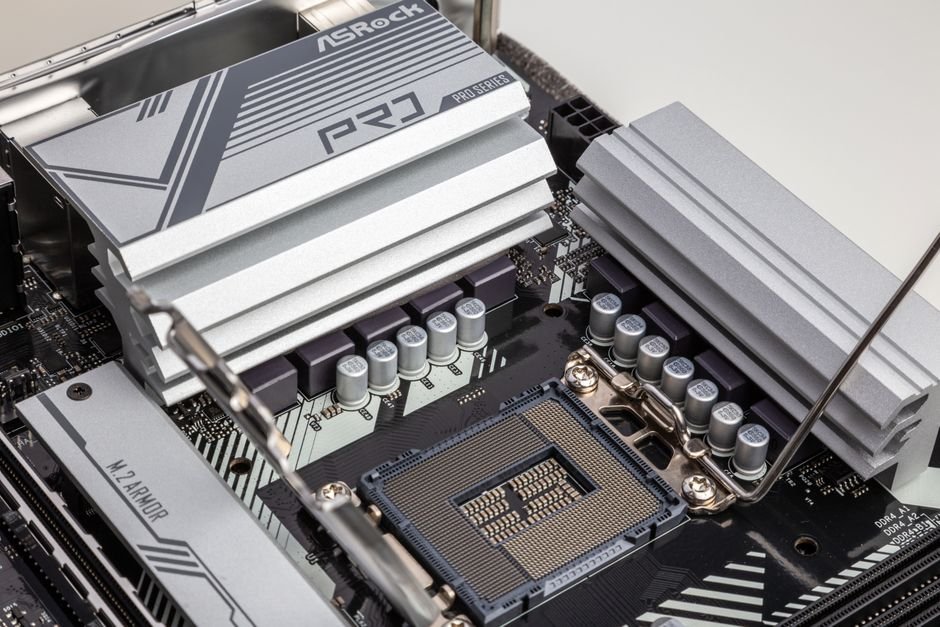
M.2 NVMe: Locate M.2 slot on motherboard (usually between PCIe slots or under a chipset heatsink). Remove screw at far end of slot. Insert drive at 30° angle, notch aligned with slot key. Press down, replace screw. Enter BIOS (Delete or F2 on boot), confirm drive appears under NVMe Configuration or Storage. If missing, reseat the drive—partial insertion is the most common error. In Windows, same Disk Management steps as SATA.
If the drive doesn’t appear: check motherboard manual to confirm that M.2 slot isn’t disabled by a BIOS setting (some boards let you allocate PCIe lanes). Confirm the drive’s keying matches the slot. Update motherboard BIOS if the drive is Gen5 and the board is more than two years old—early BIOS revisions often lacked Gen5 support.
Cloning and Migration
Both SATA and NVMe work with the same cloning tools. Samsung Data Migration (for Samsung drives), Macrium Reflect Free, or Clonezilla all handle either protocol. The target drive must be equal or larger capacity. Cloning time depends on source capacity and how full it is—expect 40-90 minutes for a 1TB boot drive.
After cloning, enter BIOS and change boot priority to the new drive. The old drive will still be bootable; you can wipe it once you confirm the new one works for a week.
Longevity and Endurance
Both use NAND flash with similar endurance ratings. A 1TB SATA drive typically has a 300-600 TBW (terabytes written) warranty. A 1TB NVMe is 300-1200 TBW depending on tier. The Samsung 870 EVO lists 600 TBW in its warranty terms; the 990 Pro lists 1200 TBW. Both figures far exceed typical consumer workloads.
The controller matters more than the protocol. A drive with DRAM cache (most SATA, high-end NVMe) will outlive a DRAMless drive under heavy write workloads because it spreads wear-leveling better. Check reviews for whether a specific model has DRAM.
Failure Modes and Fixes
Problem: NVMe drive not detected in BIOS after installation.
Fix: Reseat the drive—push down firmly until the screw hole aligns. If still missing, try a different M.2 slot; the manual may require enabling that slot in BIOS under PCIe Configuration or disabling CSM/enabling UEFI mode.
Problem: NVMe drive shows reduced write speeds after sustained file copies.
Fix: Thermal throttling per manufacturer specifications. Add a heatsink (aluminum with thermal pad, $8-15) or improve case airflow. Gen4 drives in the primary M.2 slot under a GPU can exceed thermal limits; moving to a lower slot or adding a fan helps.
Problem: SATA M.2 drive (B+M key) doesn’t appear in M-key slot.
Fix: Physical incompatibility. That slot is NVMe-only. Check the manual for a B+M slot (often labeled M.2_2 SATA/PCIE) or use a 2.5-inch SATA version of the drive in a cable-connected bay instead.
Frequently Asked Questions
Which is better SATA or NVMe SSD?
NVMe is faster in benchmarks—manufacturer specs list 3500-7000 MB/s versus SATA’s 560 MB/s—and costs only $5-15 more for a 1TB drive in 2026. For a boot drive or active project storage, NVMe’s higher published IOPS ratings make application launches and file operations noticeably snappier. SATA remains viable for game libraries or archived files where you rarely wait on the drive, and it runs cooler according to thermal specifications without throttling.
Can I use NVMe SSD in SATA slot?
No. NVMe requires PCIe lanes, which SATA ports don’t provide. An M.2 NVMe drive (M-key) won’t fit a SATA-only M.2 slot (B-key) due to physical notch position. Some M.2 slots support both protocols (B+M key), but you must install a drive matching that protocol—check your motherboard manual’s M.2 specifications table. A 2.5-inch SATA cable port will never accept NVMe.
Is NVMe worth the extra cost over SATA?
For a primary boot drive, yes—the $10-20 premium buys higher IOPS ratings that translate to faster application launches and better multitasking responsiveness. For secondary storage holding games or media files, the benefit shrinks. Most games show modest loading time improvements with NVMe, which matters in competitive play but not casual use. If the drive will sit idle 90% of the time, SATA saves money without practical compromise.
Which is faster SATA or NVMe SSD?
NVMe is 6-12 times faster in sequential reads according to published specifications (3500-7000 MB/s for Gen3/Gen4 NVMe versus 560 MB/s for SATA III) and 4-5 times faster in random 4K IOPS per manufacturer datasheets. Real-world tasks like booting Windows, opening Photoshop, or loading a game level show measurable time reductions with NVMe. Large file copies see the biggest gap due to sequential speed differences.
What is the difference between SATA and NVMe SSD?
SATA uses the older AHCI protocol over SATA cables or M.2 B+M slots, capped at 560 MB/s by the interface specification. NVMe uses the PCIe bus directly through M.2 M-key slots or PCIe cards, with published specs reaching 3500-7000 MB/s depending on generation. Physically, SATA SSDs come as 2.5-inch drives with cables or M.2 sticks with two notches; NVMe is M.2 with one notch or add-in cards. Both use flash storage, but NVMe’s parallel command queues handle multitasking better.