Key takeaways
- Set app-specific time blocks (10pm-7am) using Screen Time App Limits on iOS or Digital Wellbeing Bedtime mode on Android, and enable the Block at End or app pausing feature to enforce it.
- Layer a Focus mode (iOS) or Bedtime Do Not Disturb (Android) on top of app limits to stop lock screen notifications—Downtime alone doesn’t block them.
- Enable scheduled grayscale mode to make apps visually unrewarding, and remove social apps from your home screen to add friction between unlock and scroll.
- Check your weekly Screen Time or Digital Wellbeing report to see if your usage is dropping; if you’re still over an hour a night and overriding limits, delete the apps for a week or charge your phone outside the bedroom.
How to Stop Doomscrolling at Night: Block Apps After 10pm
Set app-specific time blocks that prevent social and news apps from opening after 10pm. On iPhone: Settings > Screen Time > App Limits > Add Limit, select Social (or pick Instagram, TikTok, X individually), set 10:00pm to 7:00am, toggle Block at End of Limit. On Android: Settings > Digital Wellbeing > Dashboard, tap the app, set a timer, then Bedtime mode > Customize > Choose apps to pause and add your time window. This blocks the app icon. You can override it by tapping “Ignore Limit” and entering your passcode, but the two-step friction is enough to snap most people out of autopilot—though not everyone, which is why you need the layers below.
The limitation: notifications still land on your lock screen and pull you back in. Fix that in step three.
What Happens, Why, and Which Setting Fixes It
| What happens | Why it happens | Setting to change |
|---|---|---|
| You pick up your phone “just to check” at 11pm and surface at 1am | No friction between unlock and app launch | App Limits with Block at End enabled (iOS) or App Timers + Bedtime mode (Android) |
| Lock screen lights up with news or social notifications after bedtime | Downtime and Focus modes don’t block notifications by default | Focus mode with custom notification filtering (iOS) or Bedtime mode Do Not Disturb (Android) |
| You open one app, then reflex-swipe to three others | Muscle memory and colour cues | Grayscale display mode |
| You tell yourself “five more minutes” six times | No accountability or visible cost | Screen Time weekly report (iOS) or Digital Wellbeing dashboard with comparison to last week (Android) |
Block Apps After 10pm (And Add Passcode Friction)
iOS: Screen Time App Limits
Go to Settings > Screen Time > App Limits > Add Limit. Tap Social or Entertainment to block entire categories, or choose individual apps. Set your window—say, 10:00pm to 7:00am. Toggle on Block at End of Limit. Without that toggle, iOS shows a gentle reminder you can dismiss in one tap. With it, you have to enter your Screen Time passcode or tap “Ignore Limit for Today.”
The problem: if you set your own passcode, you’ll remember it and override the block within three days. The workaround is to generate a random passcode, write it on paper, and store it somewhere inconvenient—top of a closet, inside a book you never open. You can still retrieve it in an emergency, but the friction of walking across the room and digging it out is enough to break the reflex. Or give the passcode to someone you live with and ask them not to share it unless you have a genuine reason.
Android: Digital Wellbeing App Timers + Bedtime Mode
Settings > Digital Wellbeing & parental controls > Dashboard. Tap the app you want to limit, set a daily timer (say, 30 minutes), then go to Bedtime mode > Customize > Choose apps to pause. Add the same apps. Set your bedtime schedule—10:00pm to 7:00am. When Bedtime mode starts, those apps gray out and won’t open. The timer gives you a daily budget; Bedtime mode enforces the night window.
The catch: both systems let you override with a few taps. Android lets you set an unlock PIN for Digital Wellbeing, which someone else can set for you—go to Settings > Digital Wellbeing > three-dot menu > Manage unlock verification. If you live alone, you can still set a PIN, forget it, and rely on the account recovery process to reset it if you genuinely need access. That’s a 24-hour delay, which is enough to kill the impulse.
Stop Notifications from Lighting Up Your Lock Screen After 10pm
Here’s what most guides miss: iOS Downtime still allows notifications to appear on your lock screen. You’ll see the headline, the first two lines of the reply, the like count. That’s enough to pull you in. The fix is layering a Focus mode on top of Downtime.
iOS: Sleep Focus + Allowed Notifications
Settings > Focus > Sleep (or create a custom Focus). Under Allowed Notifications, choose People and pick only your partner, kids, or emergency contacts. Leave Apps empty or add only Phone and Messages. Scroll down and toggle on Dim Lock Screen. Set a schedule that matches your App Limits window—10:00pm to 7:00am. Now when Downtime blocks Instagram, Sleep Focus also silences its notifications so you never see them.
The weakness: if you manually turn off Sleep Focus—swipe down from the top right, long-press the Focus icon, tap Sleep—all your notifications come flooding back. There’s no passcode lock for Focus modes. The only real fix is to make it a reflex to leave it on, which takes about a week of conscious effort.
Android: Bedtime Mode Do Not Disturb
When you enable Bedtime mode in Digital Wellbeing, it automatically turns on Do Not Disturb. Go to Settings > Sound & vibration > Do Not Disturb > People and choose who can break through (starred contacts, anyone, or no one). Under Apps, leave it at “No apps” unless you need delivery or security alerts. Bedtime mode also grays out the lock screen and hides notification content—just a count, no previews.
The downside: if you turn off Bedtime mode manually from the Quick Settings tile, Do Not Disturb also turns off. You’re back to full notifications. Android doesn’t let you password-protect the Bedtime toggle, so the only enforcement is self-discipline or removing the Quick Settings tile entirely—swipe down twice, tap the pencil, drag Bedtime mode out of the visible tiles.
Make Your Phone Ugly (Grayscale Strips Dopamine Cues)
Colour is a dopamine cue. Red notification badges, blue Twitter birds, orange Instagram gradients—all designed to grab your eye. Grayscale strips that out. Apps still work, but they’re boring to look at.
iOS: Colour Filters
Settings > Accessibility > Display & Text Size > Colour Filters, toggle on, select Grayscale. To toggle it quickly at bedtime, go to Settings > Accessibility > Accessibility Shortcut and choose Colour Filters. Now triple-click the side button to flip between colour and grayscale.
Android: Bedtime Mode Grayscale
Grayscale is built into Bedtime mode. Settings > Digital Wellbeing > Bedtime mode > Customize > Grayscale. It turns on automatically with your schedule. To toggle it manually, add a Quick Settings tile: swipe down twice, tap the pencil icon, drag Bedtime mode into your tiles.
Some people leave grayscale on all day. It works, but it makes photos look flat and maps harder to read—Google Maps colour-codes traffic, and that disappears in grayscale. A scheduled toggle is more practical. The real problem with grayscale is that your brain adapts to it in about four days, and then it stops being a deterrent. You’ll scroll in grayscale just as easily as you did in colour. It buys you a week of reduced usage, not a permanent fix.
Remove Social Apps from Your Home Screen (Add 3 Seconds of Friction)
If you have to swipe to the App Library (iOS) or open the app drawer (Android) and type three letters, you’ll catch yourself more often. Move Instagram, TikTok, X, Reddit, and news apps off the first page. On iPhone, long-press the app, tap Remove App > Remove from Home Screen—it stays in the App Library. On Android, long-press and drag it off the home screen into the drawer.
Put something useful in that spot: a book app, a podcast player, a white noise app. You’ll still reflex-tap the empty space for a day or two, which is clarifying. The limitation: this only works if you don’t use Spotlight search (iOS) or the app drawer search (Android) to launch apps by typing the first letter. If you do, you’ve just replaced a one-tap reflex with a two-tap reflex, which isn’t enough friction.
Set a Daily Time Budget and Check Your Weekly Screen Time Report
Knowing you spent 18 hours on TikTok last week creates accountability. Both platforms show you a weekly report.
iOS: Screen Time Summary
Settings > Screen Time > See All Activity. Tap Week. You’ll see total screen time, most-used apps, pickups, and notifications. Look at the Social and Entertainment categories. If they’re over 2 hours a day on average, set App Limits for those categories and check back in seven days. The report also shows you how many times you picked up your phone—if it’s over 100 pickups a day, your problem isn’t app limits, it’s reflex unlocking.
Android: Digital Wellbeing Dashboard
Settings > Digital Wellbeing > Dashboard. Tap the chart at the top to see a week view. It breaks down unlocks, notifications, and time per app. Compare this week to last week. If the number isn’t moving after you’ve set limits, your current limits aren’t tight enough or you’re overriding them too often.
The weakness: the report only matters if you look at it. Set a calendar reminder for Sunday evening to check it. If you ignore the reminder, the data is useless.
Charge Your Phone Outside the Bedroom (Removes the Option Entirely)
Not a phone setting, but it’s the most effective intervention if the others aren’t enough. A Casio alarm clock costs £9 on Amazon UK as of September 2026 (model F-91W). Charge your phone in the kitchen or bathroom. You’ll lose the ability to doomscroll in bed.
The downside: you also lose your phone as an emergency contact device overnight. If that’s a concern, enable Sleep Focus or Bedtime mode so only starred contacts can ring through, then keep the phone on a dresser across the room—far enough that you have to stand up to reach it. The other downside: if you use your phone for white noise, meditation apps, or sleep tracking, this breaks that workflow. You’ll need a separate speaker or sleep tracker.
iOS vs Android: Which System Blocks Better
| Feature | iOS (Screen Time + Focus) | Android (Digital Wellbeing) |
|---|---|---|
| App-specific time windows | App Limits with custom schedule, requires Block at End toggle | App Timers + Bedtime mode app pausing, both needed for night enforcement |
| Block lock screen notifications | Requires separate Focus mode; Downtime alone doesn’t stop them | Built into Bedtime mode Do Not Disturb |
| Grayscale scheduling | Manual toggle via Accessibility Shortcut or Shortcuts automation | Built into Bedtime mode schedule |
| Override friction | Screen Time passcode (optional, self-set, easy to remember and bypass) | Digital Wellbeing unlock PIN (optional, can be set by another person) |
| Weekly usage report | Screen Time > See All Activity, shows pickups and notifications | Dashboard with week view and comparison to previous week |
iOS gives you more granular control but requires layering two systems (Screen Time + Focus) to fully block apps and notifications. Android consolidates most of it into Bedtime mode, which is simpler but less customizable—you can’t, for example, block Instagram but allow YouTube during the same window without setting individual app timers. The bigger problem with both systems: they rely on you not overriding them. Neither platform makes it genuinely hard to bypass the limits. A determined user can disable everything in under 30 seconds.
When App Limits Don’t Work (3 Reasons Settings Fail)
If you’ve set every limit here and you’re still opening Instagram at 11pm every night, the friction isn’t enough. That points to one of three things:
- You’re overriding the limits every night. Check your Screen Time or Digital Wellbeing report—it shows you how many times you tapped “Ignore Limit.” If it’s more than twice a week, set a Screen Time passcode you don’t memorize (write it down and store it across the room) or delete the apps entirely for seven days to break the loop. Reinstalling them after a week-long break gives you a clean slate.
- Your phone is your only evening entertainment. If you’re doomscrolling because you’re bored and there’s nothing else to do, no app limit will fix that. The phone is filling a gap. Put a book, a puzzle, or a drawing pad next to your bed. Or accept that you’re going to scroll and set a hard 30-minute timer with a physical alarm clock—when it rings, the phone goes on the charger across the room.
- You’re checking the phone to avoid something. If you’re scrolling to defer a conversation, ignore anxiety, or avoid lying awake with your thoughts, that’s outside the scope of phone settings. A screen time limit will just move the behaviour somewhere else—you’ll switch to scrolling news sites in a browser, or you’ll pick up a tablet, or you’ll turn on the TV. The compulsion is the problem, not the device.
None of those are hardware or software problems. They’re habit problems that need a different kind of fix.
When to Stop Tweaking Settings (30 Minutes or Less Is the Target)
You don’t need to get to zero phone time at night. If you’ve gone from 90 minutes of social media after 10pm to 20 minutes of reading articles or replying to messages, that’s a win. The goal is to stop the behaviour where you pick up the phone with no intent and lose an hour. Check your Screen Time or Digital Wellbeing report: if Social and Entertainment apps are under 30 minutes after 10pm on average, and you’re sleeping better, you’re done.
If you’re still over 60 minutes after 10pm and the limits aren’t working, the next step is to delete the apps for seven days and see what changes. You can reinstall them. But a week-long break will show you how much of your evening they were eating and whether you actually miss them.
Frequently Asked Questions
How to stop doomscrolling at night?
Set app-specific time blocks that prevent social and news apps from opening after 10pm. On iPhone, use Screen Time App Limits with Block at End enabled and layer a Sleep Focus mode to silence notifications. On Android, enable Bedtime mode in Digital Wellbeing to pause apps and turn on Do Not Disturb. Both systems let you override with a passcode, so write down a random passcode and store it somewhere inconvenient, or give it to someone you live with. Add grayscale mode and remove apps from your home screen for extra friction.
How to stop doomscrolling before bed?
Enable grayscale mode an hour before bed to make your screen less visually rewarding—iOS under Accessibility > Colour Filters, Android as part of Bedtime mode. Charge your phone outside the bedroom or at least across the room so you have to stand up to reach it. Set a daily time budget for social apps and check your weekly Screen Time or Digital Wellbeing report to see if the number is dropping. If you’re still over 60 minutes after 10pm, delete the apps for a week.
How to stop doomscrolling addiction?
Layer multiple friction points: app time limits with passcode enforcement, notification blocking via Focus or Bedtime mode, grayscale, and home screen removal. If you override limits every night, set a Screen Time passcode you don’t memorize or delete the apps for seven days to break the reflex. Track your usage with Screen Time or Digital Wellbeing weekly reports. If you’re still over 60 minutes a day on social apps after two weeks of limits, the phone is filling a gap—boredom, anxiety, or lack of other evening activities—that needs a non-digital solution.
What phone settings prevent late-night scrolling?
App Limits with a 10pm-7am window and Block at End toggle (iOS), or App Timers plus Bedtime mode app pausing (Android). Add a Focus mode (iOS) or Bedtime Do Not Disturb (Android) to stop lock screen notifications from pulling you back in. Enable scheduled grayscale to make apps visually boring. Remove social apps from your home screen so you have to open the app drawer and search. Check your weekly usage report to see if the changes are working—if Social apps are still over 30 minutes after 10pm, tighten the limits or delete the apps.
What Works: Friction Beats Willpower
App Limits and Bedtime mode work if you don’t override them. Grayscale works for about four days before your brain adapts. Charging your phone outside the bedroom works because it removes the option entirely. The settings that don’t work: gentle reminders, app usage trackers with no enforcement, and wellness apps that require you to remember to open them. You’re trying to stop a reflex, not build a new habit. Friction beats willpower. The best friction is a two-step passcode you don’t remember, or a phone that’s physically out of reach.
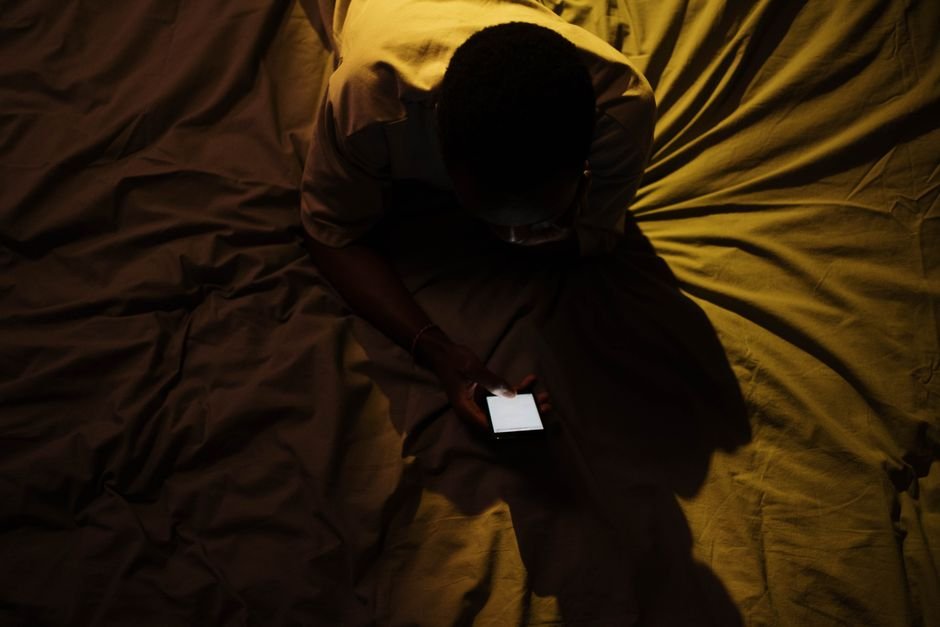
Photo by cottonbro studio on Pexels