Key takeaways
- You can use an air fryer with zero accessories—the included basket handles fries, chicken, vegetables, and reheating.
- Accessories matter when you want to bake (need a solid pan), cook two items separately (need a rack or divider), dehydrate (need stackable mesh trays), or reduce cleanup (liners or mats).
- Compatibility depends on basket size and shape: measure your basket interior in inches before buying, and leave a quarter-inch gap so the drawer closes.
- Generic accessory sets that match your measurements work identically to brand-name kits at 30–50% lower cost; brand only matters for replacement baskets with model-specific latches.
- Skip accessory sets with items you already own (tongs, mitts, timers) or single-purpose molds you’ll rarely use—buy only what solves a problem you actually have.
Most air fryers need zero accessories to cook the foods that made you buy one: fries, wings, salmon, Brussels sprouts. The basket that came in the box handles all of that. Accessories become useful when you want to bake a cake, grill kebabs, reheat pizza without it going soggy, or cook two things at once without flavours mixing. The catch: a rack designed for a 5.8-quart round basket won’t fit a 3.7-quart square one, and buying the wrong size means a drawer that won’t close or a pan that rattles around uselessly.
The oven rack principle: how air fryer accessories use vertical space
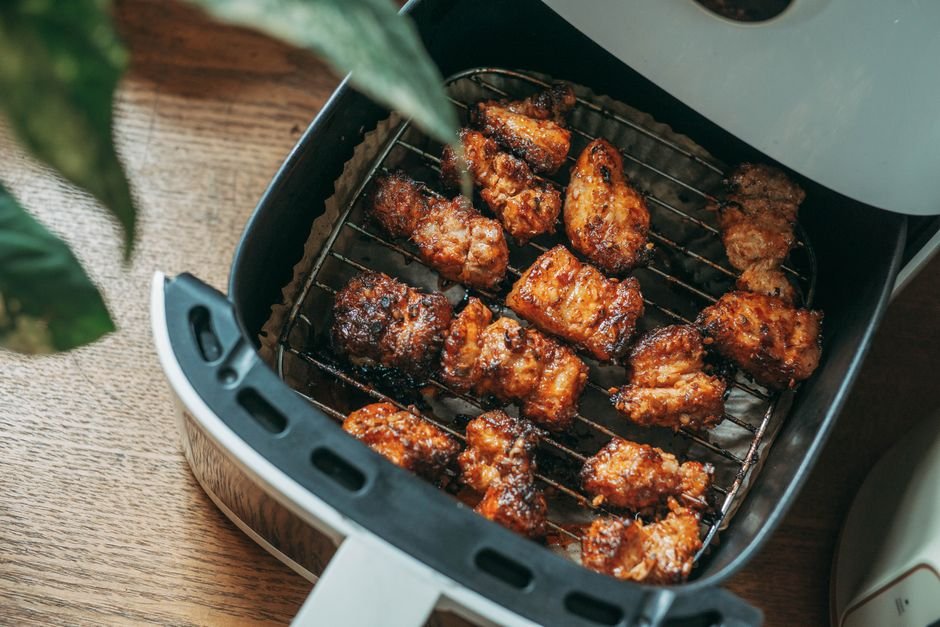
Think of your air fryer basket as a tiny convection oven with a fan at the top. The basket itself is the floor. Accessories are shelves, dividers, and specialised pans that let you use the vertical space or change the cooking surface. A raised rack lifts food closer to the heating element for browning. A pizza pan creates a flat surface where the perforated basket would let toppings fall through. A silicone liner catches grease so you don’t scrub the basket. None of them change how the air fryer heats—they just change what sits where inside the chamber.
The compatibility problem is geometry. Air fryer baskets come in round or square footprints, measured in quarts (volume) but sold with accessories sized in inches (diameter or width). A 5.8-quart Cosori is roughly 8.5 inches square. A 5.3-quart Ninja is 9 inches round. An “8-inch accessory set” fits one but not the other, even though the quart ratings sound similar.
Accessory sizing and typical set costs: $15–50 by basket volume
| Basket size | Typical dimensions | Accessory fit | Set cost |
|---|---|---|---|
| 3.7 qt (compact) | 7–7.5 inch round or square | 6.5–7 inch accessories | $15–25 |
| 5.8 qt (standard) | 8–8.5 inch square, 9 inch round | 7.5–8 inch accessories | $20–35 |
| 8 qt (family size) | 9.5–10 inch square | 9–9.5 inch accessories | $25–40 |
| Dual-zone models | Two separate baskets | Measure each basket individually | $30–50 for both |
Generic accessory sets on Amazon list dimensions in the product title. Measure your basket’s interior width or diameter with a tape measure before you buy. Leave a quarter-inch gap on each side so the drawer closes. Manufacturer-branded accessory kits from Cosori, Ninja, or Instant Brands typically list for $35–50, while universal sets with identical materials and sizing sell for $20–30 on Amazon or at restaurant supply stores.
Brand-name vs. universal fit: warranty claims that don’t hold up
Air fryer brands sell their own accessory packs and imply in the marketing that third-party items might not work or could void your warranty. This is misleading. An air fryer is a metal basket inside a heating chamber. A silicone mat or steel rack can’t void anything unless you jam it in so badly you break the drawer mechanism. What matters is size, not brand. A $22 universal set from a kitchen supplier with the right measurements works identically to a $40 Ninja-branded kit, because both are inert metal and silicone sitting in hot air.
The one exception: replacement baskets and crisper plates. Those are model-specific and usually worth buying from the original manufacturer, because the latch points and handle fittings vary. But racks, pans, skewers, and liners are commodity items.
Five scenarios where accessories solve a real limitation
If you bought an air fryer to replace deep-frying and you’re happy making chicken tenders, roasted vegetables, and reheated leftovers, you need nothing. The basket does that. Accessories become relevant when you hit a limitation.
You want to bake: The perforated basket lets cake batter drip through. You need a solid cake pan (usually 7 inches for a 5.8 qt fryer). A pan also works for frittatas, cornbread, brownies. Essential if you bake monthly, pointless if you don’t. The downside: most cake pans sold in air fryer sets are thin aluminium that warps above 375°F, leaving a wobbly pan that tips when you pull it out. Look for pans listed as 1mm thick or heavier.
You want to cook two items that need different temperatures or shouldn’t touch: A divider or double-layer rack lets you put salmon on the bottom and asparagus on a rack above it. The asparagus finishes faster; you pull the rack at 8 minutes and leave the salmon for 12. Useful if you meal-prep or cook for two people with different preferences. The problem: double-layer racks reduce airflow, so items on the bottom rack often need an extra 2–3 minutes compared to cooking them alone. You’re trading convenience for slightly longer total cook time.
You want to dehydrate fruit or make jerky: Dehydrating needs thin slices spread in a single layer with airflow underneath. Stackable mesh racks (usually sold in sets of three or five) let you fit 2–4 cups of sliced apple in a fryer that would hold half a cup in the basket alone. According to Ninja’s dehydrator function guide, apple slices at 135°F take 6–8 hours; beef jerky at 160°F takes 4–5 hours depending on thickness. If you dehydrate twice a year, borrow a friend’s dehydrator. If you do it weekly, an $18 rack set makes sense, though the racks are flimsy wire that bends if you press too hard when washing.
You hate scrubbing baked-on grease: Parchment liners (perforated circles, $8 for 100) or reusable silicone mats ($12) catch drips. The liner goes under the food. You toss it after cooking. The silicone mat goes in the dishwasher but tends to stain yellow after a dozen uses with fatty chicken thighs—it still works, it just looks dingy. Both prevent the nonstick coating on your basket from wearing down as fast, which matters if you cook bacon or sausages multiple times a week.
You want to grill skewers or reheat pizza: Skewer racks hold kebabs horizontally so they rotate for even browning (though you still have to turn them manually at the halfway point). A pizza pan or crisper tray keeps the crust from falling through the basket holes. Both are single-purpose. The skewer rack’s slots are usually spaced 1.5 inches apart, which is too wide for thin satay sticks—they fall through. The pizza pan works but adds 2–3 minutes to reheat time compared to placing slices directly on the basket, because the solid metal blocks airflow underneath. Buy them only if you cook that specific food often enough to justify the drawer space they take up when not in use.
Matching accessories to what you actually cook
| What you want to cook | Minimum accessory | Nice to have |
|---|---|---|
| Cakes, quiche, casseroles | 7–8 inch round cake pan (solid bottom) | Springform pan for cheesecake |
| Two proteins at once | Double-layer rack | Divider insert |
| Dehydrated fruit, jerky | Stackable mesh racks (3-pack minimum) | Silicone mat to catch drips |
| Pizza, quesadillas, flatbreads | Perforated pizza pan or crisper tray | None |
| Kebabs, satay, skewered vegetables | Skewer rack with 4–6 slots | None |
| Less cleanup on fatty foods | Parchment liners (disposable) or silicone mat | Grill pan with raised ridges to lift food out of grease |
| Eggs, toast, small reheats | None (use basket as-is) | Egg bite mold if you meal-prep breakfast |
The “nice to have” column lists items that improve the result but aren’t blockers. You can bake a cheesecake in a regular cake pan and run a knife around the edge to release it. A springform pan just makes it easier. You can dehydrate without a silicone mat and wipe the basket afterward, though you’ll spend an extra minute scrubbing dried fruit sugar off the bottom.
Items in accessory sets that duplicate what you already own
Accessory sets often include items that duplicate what you have or solve problems that don’t exist. Silicone tongs: you already own tongs. Magnetic cheat-sheet timecards: your phone has a timer. Corn holders and oven mitts: same. Oil sprayers are useful if you don’t already own one, but they’re not air-fryer-specific. The valuable items in a typical eight-piece set are the rack, the cake pan, and maybe the silicone mat. The other five pieces are drawer clutter.
Speciality molds for egg bites, muffins, or mini pizzas are only worth it if you make that exact food weekly. A standard muffin tin from your cupboard works in most air fryers if it fits the basket dimensions. Measure before you buy a duplicate.
Frequently asked questions
Do you need accessories for air fryer?
No. An air fryer works fine with nothing but the basket it came with for frying, roasting, and reheating. Accessories expand what you can cook—baking, dehydrating, grilling—and make some tasks more convenient, like cooking two items separately or reducing cleanup. If you’re satisfied with what the basket already does, you don’t need to buy anything else.
What are essential air fryer accessories?
There are no universally essential accessories because it depends on what you cook. A solid cake pan is essential if you bake but useless if you don’t. Parchment liners or a silicone mat are essential if you hate scrubbing grease but unnecessary if cleanup doesn’t bother you. A double-layer rack is essential for cooking proteins and vegetables simultaneously but pointless if you cook one item at a time. Match accessories to your actual cooking habits, not a generic checklist.
Which air fryer accessories are best?
The best accessory is the one that fits your basket size and solves a specific problem you have. For most users, a double-layer rack and a solid cake pan cover the widest range of tasks beyond basic frying. Silicone mats or parchment liners rank high for anyone cooking fatty proteins often. Avoid accessory sets with items you already own (tongs, mitts) or single-purpose molds you’ll use twice. Measure your basket interior before buying to ensure fit.
How to use air fryer accessories?
Place accessories inside the basket before preheating, or add them after if the item (like parchment) shouldn’t preheat empty. Racks and pans sit flat on the basket floor or clip onto the sides if they have brackets. Leave space around the edges for air to circulate—accessories that touch all four walls block airflow and cause uneven cooking. Most metal and silicone accessories tolerate 400°F, but check the product listing. Remove accessories with tongs or oven mitts; they get as hot as the food.
Are ninja air fryer accessories dishwasher safe?
Most Ninja-branded and third-party metal racks, pans, and silicone mats are dishwasher-safe on the top rack, but the product packaging or manual will specify. The main basket and crisper plate that came with the fryer are usually dishwasher-safe, though hand-washing extends the nonstick coating’s life. Avoid the dishwasher for accessories with wooden handles or uncoated carbon steel, which can rust. When in doubt, hand-wash with dish soap and a soft sponge.
Photo by FOX ^.ᆽ.^= ∫ on Pexels